Tuesday, December 8, 2015

ART 211: Robotic Spider Dress
Intel Edison created a mechanical, virtual piece of clothing that is both visually unique and mechanically unique. The dress is intended to represent a spider, and wraps around the woman's body with its tentacles. The interesting part of the dress is that it responds to external stimuli. For instance, if the woman is approached in a rough manner, the tentacles will respond to protect the woman. If the woman is approached gently, the dress will respond in a soft seductive manner.
This dress, while it is interesting, is not something I foresee becoming a trend in the future. Mostly because of resources and finances. I also believe that it would take away the value of a human being to have the ability to use their own body parts to act in response to stimuli. For the sake of the design and art, this piece is very creative and smartly designed.
This dress, while it is interesting, is not something I foresee becoming a trend in the future. Mostly because of resources and finances. I also believe that it would take away the value of a human being to have the ability to use their own body parts to act in response to stimuli. For the sake of the design and art, this piece is very creative and smartly designed.
ART 211: Weirdest Music Videos
Music videos are a combination of numerous kinds of art: performance art, digital art, contemporary art, etc. Music videos are a visual way to aide the viewer in experiencing the music. Sometimes they tell a story, and sometimes they are simply for entertainment. Buzzfeed's article on "The 33 Weirdest Music Videos" was certainly strange. I could never understand the thought process in the producers mind for some of these videos.
One of the strangest yet most interesting videos to me was Passion Pit's "I'll be Alright," which showed a man making out with a piece of art. It used numerous other forms of performance art, such as life sized pills, a woman's head blowing up into smoke, etc. It makes me wonder if there was any symbolism behind these scenes or if it was produced for pure creativity.
One of the strangest yet most interesting videos to me was Passion Pit's "I'll be Alright," which showed a man making out with a piece of art. It used numerous other forms of performance art, such as life sized pills, a woman's head blowing up into smoke, etc. It makes me wonder if there was any symbolism behind these scenes or if it was produced for pure creativity.
ART 211: Flash Mobs
Flash mobs are a form of performance art in which large groups of people perform a song, dance, or act in the middle of an unexpected platform. Flash mobs have always been so interesting to me, and I always enjoy watching videos of them on YouTube. I have never experienced one in real life, but I would love to either watch one or be in one! I think the most interesting aspect of the flash mob is the reactions it draws from the onlookers. I watched the video of the "Frozen" flash mob in Grand Central Station. 207 actors stood frozen in place, in the middle of their action, while everyone else just walked around them or poked them to get them to move. It was humorous to hear the reactions of everyone around them; everyone was disheveled, some were confused, and some were concerned that there was actually something wrong with the people.
I give credit to the actors who do the flash mobs. To hold a pose for an extended amount of time is hard, especially if people are poking at them. Also, to keep that poker face must be tremendously difficult and require a lot of self control. I definitely would not be able to keep from smiling.
I give credit to the actors who do the flash mobs. To hold a pose for an extended amount of time is hard, especially if people are poking at them. Also, to keep that poker face must be tremendously difficult and require a lot of self control. I definitely would not be able to keep from smiling.
ART 211: Most Tattooed Woman
María José Cristerna is the woman, commonly referred to as the Vampire Woman, who has the most tattoos and body modifications in the world. Not only does she have tattoos covering almost every inch of her skin (from what I could see in the pictures) but she has numerous piercings. Her piercings are plentiful on her face, and she has many dermals in random spots. Additionally, she has body modifications such as sharpened teeth and horns implanted into her scalp. Personally, the look is not appealing to me. But I can understand how tattooing and piercing is a form of art and expression. Tattoos most of the time either tell a story or describe a person. The different array of colors on her body is definitely intriguing to look at.
The article says that Maria is a mother of four. Looking at these pictures, I can only imagine that her body modifications must've costed thousands of dollars. My question lies in how could she afford all of her work done to her body if she has four children? I'm also wondering if all the piercing, tattoos, and modifications would adversely affect her health.
All in all, the woman's art on her body is aesthetically interesting, and definitely can be viewed as an expression of art.
The article says that Maria is a mother of four. Looking at these pictures, I can only imagine that her body modifications must've costed thousands of dollars. My question lies in how could she afford all of her work done to her body if she has four children? I'm also wondering if all the piercing, tattoos, and modifications would adversely affect her health.
All in all, the woman's art on her body is aesthetically interesting, and definitely can be viewed as an expression of art.
Monday, December 7, 2015
ART 211: Sheep LED Art
A group of artists designed a very intricate project in which they used the sheep that they heard to create LED art. They wrapped strings of LED lights around each sheep, than used herders to bring them out in the field and arrange them to make certain pictures. Their last piece of art was to make a Mona Lisa out of sheep; entitled "Leonardo Baaa-vinci," which was quite humorous. They used the LED lights and put different colors on them and took photos, than arranged those photos to make the Mona Lisa. This project was extremely creative. My only concern is that those LED lights were not harmful to the sheeps skin or fur. Otherwise, I enjoyed this project as it was funny and creative.
ART 211: People as Pixels
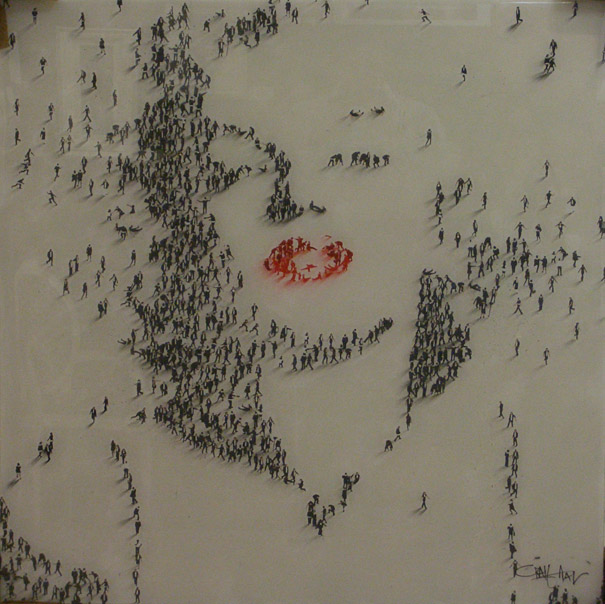 |
The "People as Pixels" article was very compelling. I thought that the idea was very creative, to arrange people together to serve as pixels for a photograph that would be taken up above. It reminded me of when I went to the my first football game, Gators vs. FSU, and the marching band arranged themselves to spell out "Gators" and put themselves in the shape of the state of Florida. I thought that was the coolest thing ever! I liked how this artist made the shapes a little more difficult. He used people to depict a portrait of a person. It makes me wonder if the artist was trying to convey a certain message, or if it was just a creative idea. Either way, I enjoyed these pieces.
ART 211: Felix the Cat Animations
Felix the Cat, an animated TV show about a cat and mice, was piloted in 1919. I watched some of the videos of the Felix the Cat and tried to compare it to animations in this day in age. Taking Avatar, one of the largest and most difficult animated movies yet, and comparing it to Felix the Cat is a tremendous comparison. The animation for Felix the Cat is very slow and pixelated. It takes multiple shots to show something as small as a tail moving or a facial expression difference. Even putting words in a word bubble takes multiple shots. It's engrossing to compare it to a movie like Avatar, which has an abundance of color and beautiful design. It's succession of animated shots moves so fast and smoothly, it hardly even seems like an animated production. Technology has really advanced from animations like Felix the Cat to Avatar. It makes me wonder the amount of work it was to put together one show of Felix the Cat, and how long that took.
ART 211: Photographs Throughout Time
Photography has been an art, science, and technology that has taken centuries to perfect, and is still improving each year. The first photograph was taken in 1826. It was a very grainy view of an estate from an upstairs window, and it hardly looks like anything. The article about photography than goes on to show how photos have progressed, and the different ways people experimented with taking photos and developing them. Having grown up in the technology era, it's hard to imagine that a photograph once took up to 30,000 seconds to capture an image. And after the image was captured, taking hours or even days to process the image. Photos are extremely common today. The phenomenon of photography blew up even more with the creation of cell phone cameras and the "selfie." It's a wonder to see how we have progressed over the decades.
ART 211: Leisure Diving
One of the more captivating links from section 4 was on "leisure diving." Leisure diving is described as jumping into a body of water, usually a pool, in a flat pose. Usually the diver will pose on their side and face the camera. The cameraman has to try to capture the pose before they loose it or fall into the water. I really enjoyed this slideshow of pictures, it was humorous to see the different ways one can be photographed chilling mid-air. My favorite shot was of the two men in the water holding up flower plants, and the man diving in holding a watering can and watering the plants on his side, mid-air. I believe that leisure diving photography could be extremely fun.


ART 211: Male Affection
The article on male affection in the earlier 1800s was very intriguing, and brought to my knowledge something that I hadn't realized before. While I did know that the term and identity of homosexuality wasn't really brought to the forefront until the very early 20th century, it didn't occur to me how men might've behaved with each other previous to the differentiation of gay and straight. These photos showed the comfort and intimacy males held with each other in their friend groups. Touching was not something that they were scared to do; in fact, it was encouraged. Many of the portraits showed men sitting on each other's laps, holding hands, their faces very close together, or their hands on each others upper legs. There appeared to be limited boundaries. It's intriguing to see these poses because if those kinds of things were to occur in this day in age, those men would automatically be called gay. Men these days only share a brief hug if there is a reunion after a long time, or if something traumatic has happened. It's fascinating to see how times have changed.
http://www.artofmanliness.com/2012/07/29/bosom-buddies-a-photo-history-of-male-affection/?fb_action_ids=10100429961300975&fb_action_types=og.likes&fb_source=other_multiline&action_object_map={%2210100429961300975%22%3A10150973012002869}&action_type_map={%2210100429961300975%22%3A%22og.likes%22}&action_ref_map=[]
http://www.artofmanliness.com/2012/07/29/bosom-buddies-a-photo-history-of-male-affection/?fb_action_ids=10100429961300975&fb_action_types=og.likes&fb_source=other_multiline&action_object_map={%2210100429961300975%22%3A10150973012002869}&action_type_map={%2210100429961300975%22%3A%22og.likes%22}&action_ref_map=[]
ART 211: Carmen Habanera
I enjoyed the YouTube video of the opera Carmen that took place in the Metropolitan in the 1970s. The opera Carmen is actually the opera that I wrote my paper on. I chose this opera for a couple of different reasons. I enjoy that the language is french, because I am actually of French-Canadian heritage and I like to try to listen to the words and make out which sentences that I can understand. Also, the music in the opera is exciting and romantic. Mostly, the aspect I enjoy the most about this opera is the storyline. The story is about a beautiful women named Carmen that has all the men in her town entranced by her beauty. They all want a chance at winning Carmen's heart. Carmen, knowing this and being confident in her good looks, uses this to her advantage. This opera differs from the rest because of it's music style, plot, and use of numerous characters. The stage is always filled with interesting props and back up characters, rather than a boring soliloquy.
ART 211: The Met
'Das Rheingold' at The Met: I enjoyed Robert Lepage's narration and take on the views of opera, and I could find myself relating to what he was saying. I myself have never been a fan of opera; I personally think that the music is a little creepy. Lepage spoke that many people do not understand the excitement behind opera and it takes a certain kind of person to appreciate it's beauty. He also spoke about the different aspects of the performances, such as the excitement it builds, the architect of the scene, and the actors and actresses that sometimes will play in an opera-based play. I do believe that if I were to enjoy opera, I would enjoy the story aspect of the music and plays that go on. I would like to see the architecture of the stage that producers and artists create.
ART 211: Paris Opera House

The photos of the Paris Opera House showed that opera houses are quite exquisite and beautiful. The architecture seems to be both Victorian, and ancient European. I can definitely admire and respect the amount of effort that directors of opera put behind their shows and music. An opera show or concert has much more artistic value than regular genres of music today sometimes have in their shows. I can see how opera appealed to the richer class, because the opera houses were very ornate and elite, and that is probably the type of audience the directors marketed opera to.
ART 211: Art vs. Design Article - Thoughts
In the Art vs. Design article by Craig A Elimeliah, the author discusses what he believes makes the difference in art and in design. As an artist, producer, and designer himself, he knows the different skill sets that each form of art require. The difference in art and design are outlined by a couple of different qualities. First, that design requires a more intricate framework and pattern. Second, while art is more thoughtful and usually expels emotion, design is not quite the same because of the planning that goes behind it. Lastly, design is based on trends and influences at the time..which is why we have different clothing and architecture fads. Art is more open to interpretation and preference.
I believe that I would prefer design over art, if given the chance to choose. I enjoy experimenting with different color patterns and schemes. I also am very detail-oriented, and I believe that personality aspect would aide me in design. Art seems to me to be more of a broad subject..open to interpretation. I tend to have difficulties completing a task when there are not detailed directions. For these reasons, design seems to be more appealing to me.
I believe that I would prefer design over art, if given the chance to choose. I enjoy experimenting with different color patterns and schemes. I also am very detail-oriented, and I believe that personality aspect would aide me in design. Art seems to me to be more of a broad subject..open to interpretation. I tend to have difficulties completing a task when there are not detailed directions. For these reasons, design seems to be more appealing to me.
Subscribe to:
Posts (Atom)